
Glaucoma (an eye pressure condition, often called 'groene staar' in Dutch) is a condition of the optic nerve that is usually associated with increased pressure in the eye. Do you have glaucoma, or are you known as a 'glaucoma suspect'? Then it is important to report this before an eyelid surgery, because the procedure can have a small, temporary effect on eye pressure.
Why is glaucoma relevant with an eyelid correction?
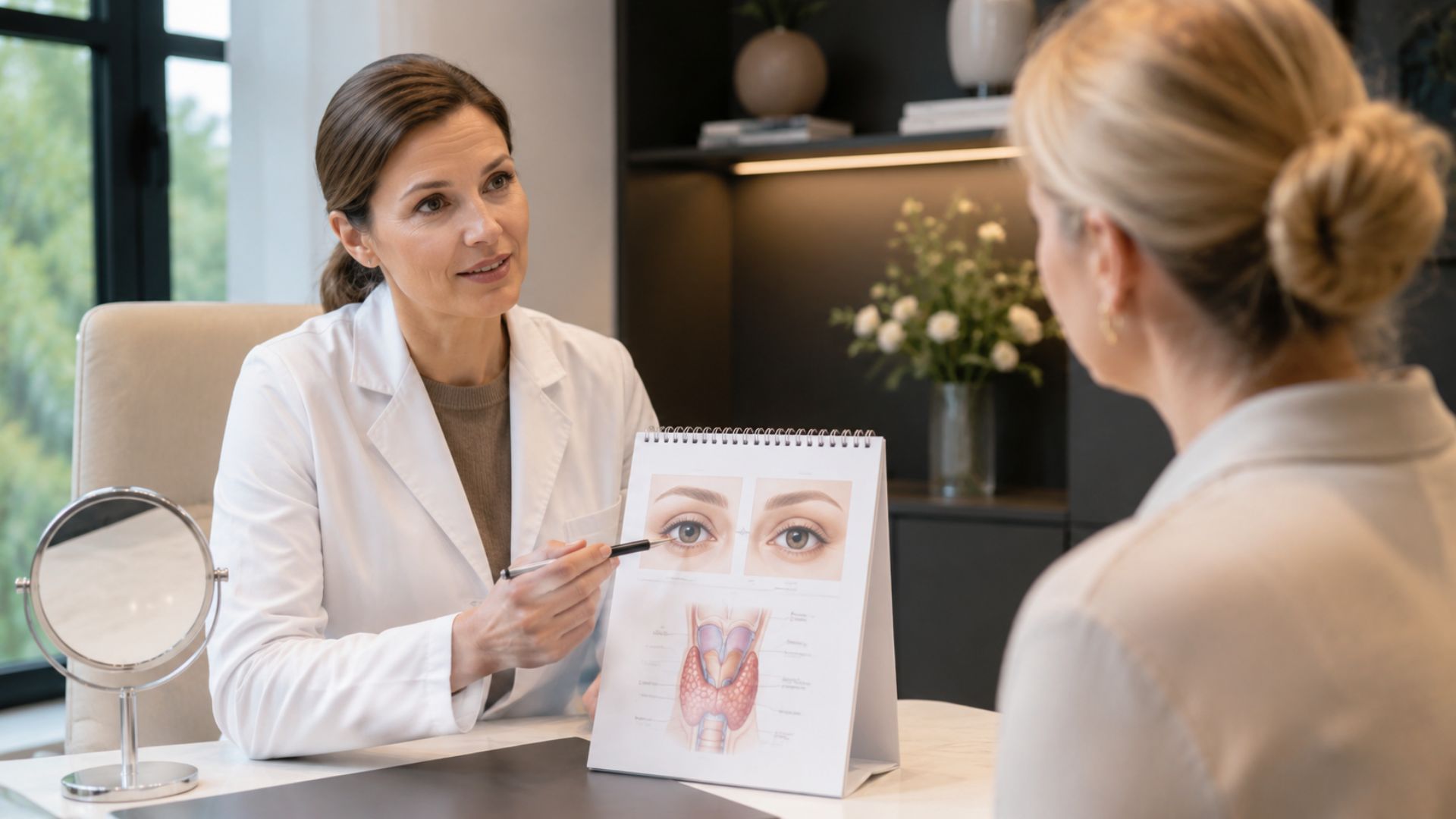
Research shows that an upper eyelid correction can lead to a slight, statistically measurable rise in the eyeball pressure (intraocular pressure, IOP) [1,4]. With healthy eyes this is usually not a problem, but in people with glaucoma or an increased risk of it, even a small rise in pressure can be significant: an increase of only 1 mmHg has been linked in earlier research to an approximately 10% higher risk of progression of glaucoma [4].
The researchers possibly explain this effect by changes in the tension of the tissue around the eye after the removal of excess skin, comparable to the so-called ‘tight orbit syndrome’ [1,4].
With a lower eyelid correction too, temporary changes in the eye pressure and the anterior chamber of the eye have been described, which usually normalise again but deserve careful monitoring in at-risk patients [3].
Points of attention
- An eyelid correction can temporarily slightly increase the eye pressure [1,3,4]
- With glaucoma or an increased risk of it, careful follow-up after the procedure is important [2,4]
- Sudden, strong pressure changes can in rare cases lead to acute complaints, as described with acute glaucoma after eyelid surgery [1]
- The use of eye pressure-lowering eye drops must simply be continued around the procedure
Discuss it in a personal consultation with plastic surgeon David Jairath, at our clinic for eyelid surgery in Haarlem. A first consultation can usually take place within a week.
Our protocol at Kliniek het Bolwerk
1. Extensive medical history
We ask whether you are known to have glaucoma, an increased eye pressure, or whether this occurs in your family.
2. Consultation with the ophthalmologist
In the case of a known glaucoma diagnosis, we request a recent assessment from your ophthalmologist, so that we know how stable your eye pressure and visual field are [2,4].
3. Continuing medication
Eye pressure-lowering drops are simply continued around the procedure.
4. Check after the procedure
With patients with glaucoma, we advise an extra check of the eye pressure after the procedure, possibly by the ophthalmologist, so that any changes are noticed early [4].
Important: glaucoma is, as a rule, not a contraindication for an eyelid correction, but requires consultation with the ophthalmologist beforehand and extra attention to the eye pressure after the procedure.
When do we advise against the procedure (for the time being)?
- In the case of unstable or poorly regulated glaucoma [2,4]
- In the case of a narrow chamber angle (increased risk of acute glaucoma), without assessment by the ophthalmologist [1]
- If the ophthalmologist advises against the procedure at this time
Our advice
Do you have glaucoma or an increased eye pressure and are you considering an eyelid correction? Discuss this during the intake consultation at Kliniek het Bolwerk. We coordinate, if necessary, with your ophthalmologist and plan an extra check after the procedure, so that you can recover safely and with peace of mind.
Literature references
The publications below form the medical-scientific basis of this article:
- Possible Influence of Upper Blepharoplasty on Intraocular Pressure. Ophthalmic Plastic & Reconstructive Surgery (PubMed). 2020. https://pubmed.ncbi.nlm.nih.gov/32658133/
- Changes in Intraocular Pressure and Ocular Biometry After Blepharoplasty. Aesthetic Plastic Surgery. 2022. https://link.springer.com/article/10.1007/s00266-021-02756-9
- Prospective Evaluation of Iridocorneal Angle and Anterior Segment Changes Following Lower Eyelid Blepharoplasty. ScienceDirect. 2026. https://www.sciencedirect.com/science/article/pii/S1572100026001808
- Upper Blepharoplasty May Raise Intraocular Pressure. Ophthalmology Advisor. 2024. https://www.ophthalmologyadvisor.com/news/intraocular-pressure-rise-may-be-influenced-by-blepharoplasty/