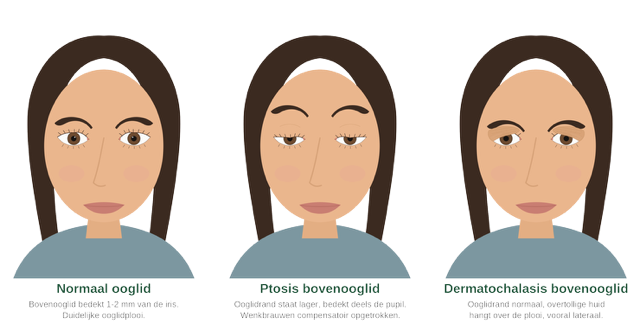

A eyelid surgery (also called blepharoplasty) is a popular procedure in which excess skin, fat or muscle tissue is removed from the upper or lower eyelids. The result is a fresher, more rested appearance and sometimes also an improvement in your field of vision. But what if you have had a herpes infection of the eye (ocular herpes) in the past? Is eyelid surgery still a responsible choice then?
In this blog, we answer the most frequently asked questions on this topic and explain how we at Kliniek het Bolwerk handle your medical history with care.
What is ocular herpes?
Ocular herpes is an eye infection caused by the Herpes Simplex Virus type 1 (HSV-1), the same virus that is also responsible for cold sores. The virus can affect the cornea, the conjunctiva or the eyelids [1]. After a first infection, the virus remains latently present for life in the trigeminal ganglion [9]. Under the influence of certain triggers, such as stress, fatigue, sunlight or a surgical procedure, the virus can become active again [2].
Forms of ocular herpes include:
- Herpes keratitis (infection of the cornea) [2]
- Herpes conjunctivitis (infection of the conjunctiva) [10]
- Herpes blepharitis (infection of the eyelids) [10]
Why does a herpes history require extra attention with an eyelid correction?
An eyelid correction is a surgical procedure in and around the eye. Surgical trauma is a known trigger for reactivation of the herpes virus [3,6,7]. Similar to how herpes reactivation has been described after laser eye corrections (LASIK, PRK), a blepharoplasty can also reactivate the virus [6,7]. A herpes reactivation after eye surgery can have serious consequences, including:
- Herpes keratitis with a risk of scarring of the cornea [2,3]
- Loss of visual acuity or, in rare cases, loss of vision [2]
- Delayed wound healing [3]
- Greater chance of postoperative complications [8]
This makes a careful medical history and consultation with your ophthalmologist beforehand absolutely necessary.
Discuss it in a personal consultation with plastic surgeon David Jairath, at our clinic for eyelid surgery in Haarlem. A first consultation can usually take place within a week.
Can an eyelid correction still take place?
In many cases an eyelid correction is also possible in patients with a history of ocular herpes, provided certain conditions are met. At Kliniek het Bolwerk we apply a careful protocol for this:
1. Free of complaints
The procedure only takes place if there has been no active herpes outbreak for a longer period (usually at least 6 to 12 months) [3,8]. With active herpes, the procedure is always postponed.
2. Antiviral prophylaxis
As standard, we advise the use of antiviral medication (aciclovir or valaciclovir) around the procedure in patients with an ocular herpes history [4,5]. The Herpetic Eye Disease Study (HEDS) showed that oral aciclovir significantly reduces the risk of recurrence of herpes keratitis [4,5]. This medication is usually prescribed a few days before and after the operation, in close cooperation with your treating ophthalmologist.
3. Consultation with the ophthalmologist
We always refer you first to your own ophthalmologist or a specialised cornea ophthalmologist for an extensive assessment of the current condition of your eye [3]. Only after approval and, if necessary, additional advice from the ophthalmologist do we plan the procedure.
4. Careful follow-up check
After the eyelid correction, a strict follow-up policy takes place. Early signs of herpes reactivation, such as redness, light sensitivity, cloudy vision or pain, are treated immediately [8].
Important: a herpes infection of the eye that has been experienced is not an absolute contraindication for an eyelid correction, but does require extra precautions and good coordination between your ophthalmologist and the plastic surgeon.
When is an eyelid correction inadvisable?
There are situations in which we advise against the procedure for the time being or definitively:
- In the case of an active herpes infection or recent outbreak (less than 6 months ago) [3,8]
- In the case of frequent recurrences (several outbreaks per year) without adequate antiviral treatment [4,5]
- In the case of severe corneal damage as a result of earlier herpes infections [2,3]
- If the ophthalmologist advises against the procedure on medical grounds
Our advice
Have you considered an eyelid correction but are you uncertain about your history with ocular herpes? Then we warmly invite you for a no-obligation consultation at Kliniek het Bolwerk. During this conversation we discuss your medical history extensively, present your situation to a specialised ophthalmologist if necessary, and draw up a safe and responsible treatment plan together with you.
Safety and quality always come first with us. We take the time to assess your individual situation, so that you can make a decision with peace of mind.
Literature references
The publications below form the medical-scientific basis of this article:
- Liesegang TJ. Herpes simplex virus epidemiology and ocular importance. Cornea. 2001;20(1):1-13. https://doi.org/10.1097/00003226-200101000-00001
- Farooq AV, Shukla D. Herpes simplex epithelial and stromal keratitis: an epidemiologic update. Surv Ophthalmol. 2012;57(5):448-462. https://doi.org/10.1016/j.survophthal.2012.01.005
- Tuli SS, et al. Surgical intervention for ocular herpes simplex virus disease. Surv Ophthalmol. 2010;55(6):527-543. https://doi.org/10.1016/j.survophthal.2010.03.005
- Herpetic Eye Disease Study Group. Acyclovir for the prevention of recurrent herpes simplex virus eye disease. N Engl J Med. 1998;339(5):300-306. https://doi.org/10.1056/NEJM199807303390503
- Herpetic Eye Disease Study Group. Oral acyclovir for herpes simplex virus eye disease: effect on prevention of epithelial keratitis and stromal keratitis. Arch Ophthalmol. 2000;118(8):1030-1036. https://doi.org/10.1001/archopht.118.8.1030
- Wollensak G, et al. Herpes simplex virus keratitis after photorefractive keratectomy. J Cataract Refract Surg. 2001;27(3):471-473. https://doi.org/10.1016/s0886-3350(00)00567-5
- Moshirfar M, et al. Reactivation of herpes simplex keratitis after laser in situ keratomileusis. J Cataract Refract Surg. 2004;30(12):2495-2497. https://doi.org/10.1016/j.jcrs.2004.04.053
- Kaufman HE. The viral diagnosis and treatment of herpes keratitis. Trans Am Ophthalmol Soc. 2011;109:210-221. https://www.ncbi.nlm.nih.gov/pmc/articles/PMC3259699/
- van Velzen M, et al. Latent infection and reactivation of herpes simplex virus in the human trigeminal ganglion. J Virol. 2009;83(19):10043-10048. https://doi.org/10.1128/JVI.00719-09
- Rootman DS, et al. Herpes simplex blepharoconjunctivitis presenting as an acute follicular conjunctivitis in childhood. Ophthalmology. 1991;98(7):1052-1055. https://doi.org/10.1016/s0161-6420(91)32155-3